The six-month shutdown at ISIS from August 2010 to February 2011 was necessary to replace a wide range of aging ISIS equipment and components, many of which were installed over 25 years ago.
Two major projects were completed successfully on time: the very difficult replacement of the downstream proton beam line to target station one, and replacement of over 2 kilometres of aging 30 year old heavy-duty electrical cabling supplying the 10,000 volt 1000 amp power to the accelerator magnets.
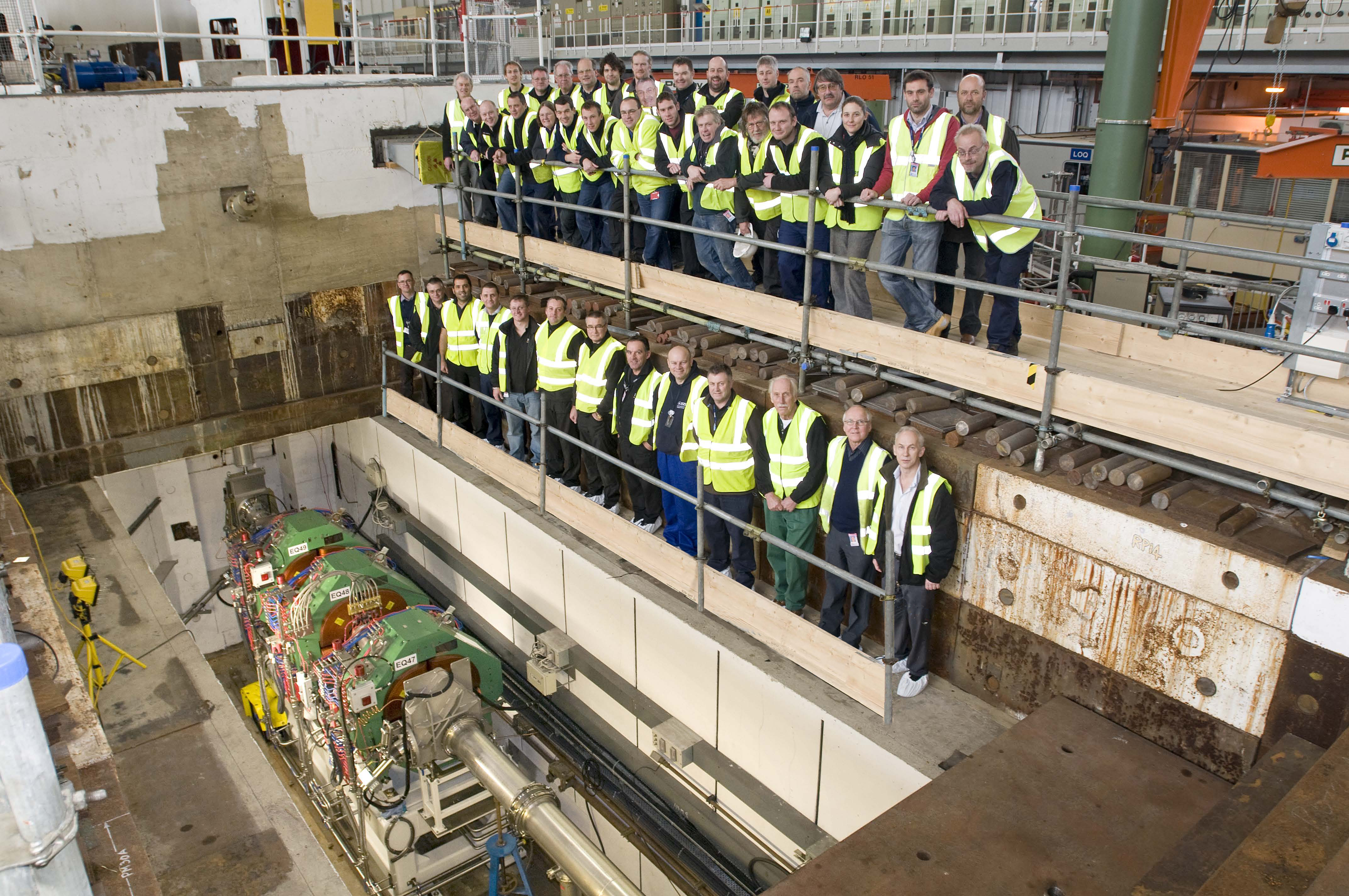
A team of 60 people worked for six months to install new magnets and beam exit window into the extracted proton beamline to target station 1
View full-size image
Around 700 other projects across ISIS were completed during the shutdown to improve performance and add new capability - approximately 200 separate tasks on the accelerators, 200 on the neutron target systems and 300 on the neutron beam lines and instruments in target station 1 and target station 2, including major rebuilds of the Pearl and Polaris neutron instruments.
Matthias Gutmann, instrument scientist for the SXD instrument won the race to begin taking the first ISIS data of 2011 with a research team from the University of Bath.
Speaking at the restart of the ISIS science programme, Andrew Taylor, ISIS Director, said: “It was delightful walking round the halls and the machine in recent days to see that order had been restored where chaos had prevailed – and that ISIS was operating again.
"My personal thanks to all the staff who worked so hard in this long shutdown and have brought ISIS back to life. It really felt like Spring after a long Winter! I am looking forward to seeing the first science results coming from the instruments in the weeks ahead.”
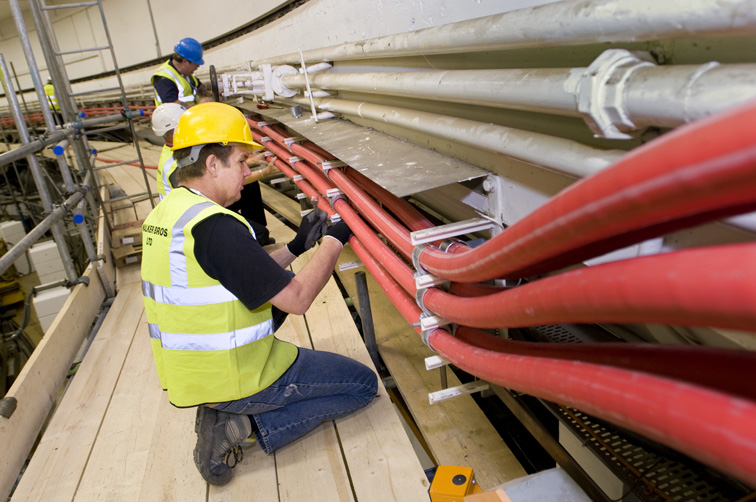
Power cables for the magnet power supplies being replaced in the Outer Synchrotron.
View full-size image