


| Bore diameter (mm) | Temperature range | |
| Pulse-tube top-loader | 100 | 4 K to 673 K |
| Orange and Blue Cryostats, with V or Al tails | 50 and 100 | 1.5 K to 330 K |
| Dilution refrigerator | 50 | down to 50 mK |
| Superconducting magnet 7.5T | 50 | 2 to 300 K |
| Furnaces | – | 18°C to 1000°C |
| Pressure rigs for gas and liquid handling | Please ask your local contact | |
In this section
Osiris
Osiris is a high-resolution spectrometer optimised for low-energy studies, ideal for probing slow dynamics like diffusion and ion movements in batteries and in nano-porous catalytic materials. Low-energy magnetic excitations can be studied in fine details. Spectroscopy and long-wavelength diffraction can be applied simultaneously.
Instrument scientists
To find out more about each team member, click the + symbol.
Technical information
| Beamline | N6 |
| Moderator | Hydrogen-cooled to 25 K |
| Wavelength limiting choppers | Disc choppers at 6.3 m and 10 m |
| Primary flight path | Curved m=2 super mirror guide for 1 m, then m=3 super mirror guide for 1.5 m with tapered end. |
| Sample position | 34 m from the moderator |
| Beam size at sample | 44 mm (v) x 22 mm (h) |
| Intensity at sample | 2.7×10⁷ n cm-2 s at 150 µA ISIS power |
Related resources
Diffractometer specifications
| Solid angle (steradians) | 0.67 |
| Angular coverage | 150° < 2θ < 171° |
| Angular resolution | 2.5×10⁻³ < Δd/d < 6.0×10⁻³ |
| d-spacing range (Å) | 0.8 – 20 |
Spectrometer specifications
| Solid angle (steradians) | 1.09 |
| Angular coverage | 11° < 2θ < 148° |
| Q-range (Å-1) | 0.18 – 1.8 (PG002) 0.37 – 3.6 (PG004) |
| Energy resolution (μeV) | 25.4 (PG002) 99.0 (PG004) |
| Dynamic range (meV) | -0.4 to +0.4 (PG002) -3.0 to +4.0 (PG004) |
| Analysing energy (meV) | 1.84 (PG002) 7.38 (PG004) |
Sample environment
Osiris accepts a wide range of sample environments. Two different sample geometries can be used:
- Flat – aluminium alloy cans of 40 mm x 40 mm for powders, liquids or films, with varying thicknesses (0.1, 0.2, 0.25, 0.3, 0.4, 0.5, 1, 2 mm)
- Annular – aluminium alloy cans 50 mm tall for powders, liquids or films, with varying thicknesses (0.1, 0.25, 0.5, 1, 1.5 and 2 mm)
- Annular with gas loading capabilities (please ask your local contact)
Common sample environments
Software
Online training: Quasielastic Neutron Scattering Course (Totara)
The main software package used to analyse data from Osiris is Mantid, which performs both data reduction and analysis.
Data Reduction involves converting measured time-of-flight (tof) data into S(Q,ω). Operations include:
- Converting from tof to energy transfer (or other units eg. d-spacing
- Summing of spectra into groups and converting from detector angle to Q-value
- Absorption, empty cell and multiple scattering corrections (if necessary)
Data Analysis refers to science-based interpretation of the reduced data. Operations include:
- Fitting quasi elastic peaks using the convolution method
- Calculating peak parameters using Bayesian analysis
- Fitting peak widths to various available diffusion/rotation models
- Performing Fourier Transformation of S(Q,ω) to I(Q,t)
- Fitting scattering functions to various models including stretched exponential decays
Other software for data analysis
MDANSE
Atomistic simulations, particularly molecular dynamics (MD) simulations are increasingly being used for analysis of quasielastic neutron scattering data. MD provides in-depth microscopic interpretation of quasielastic neutron scattering data. Molecular Dynamics Analysis of Neutron Scattering Experiments (MDANSE) is the software available for this analysis.
Osiris silicon analyser upgrade
Osiris is currently being upgraded with the addition of a silicon analyser, positioned on the vacant side inside the vacuum tank of the secondary spectrometer. The current pyrolithic graphite analysers (PGA) on Osiris provides a maximum spectral resolution of about 25 µeV (pg002) at the elastic line, enabling access to relaxation times up to 140 ps. Using the (111) reflection plane of silicon analyser, Osiris will extend these timescales to ca. 400 ps as a result of an improvement in spectral resolution by a factor of 2.5 (resolution of 11 µeV). This development increases the dynamic range of the instrument to ca. 1,000.
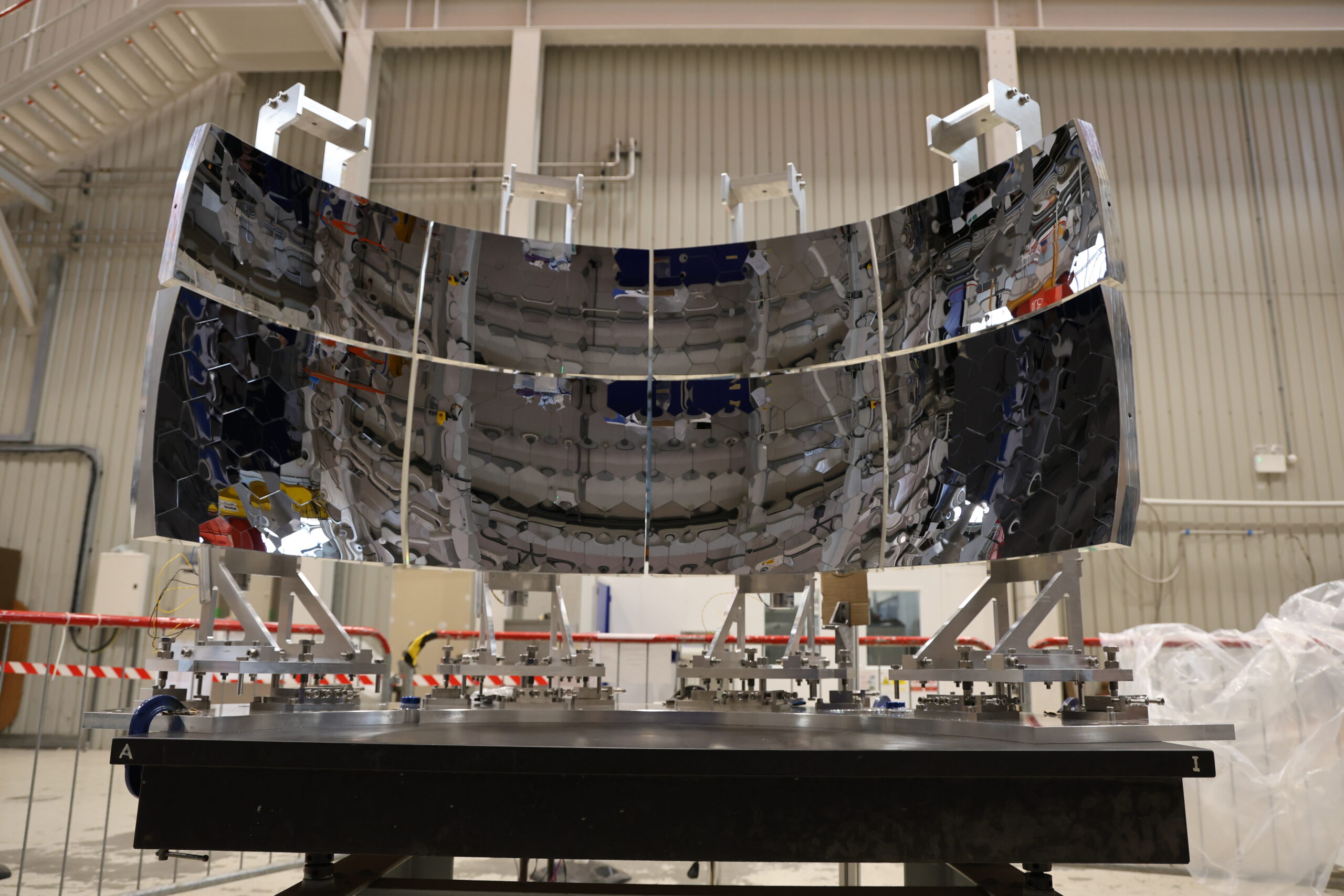
The analyser towers
An inherent advantage of the silicon analyser is that such an increase in spectral resolution does not affect the wide momentum-transfer range currently available on the instrument. Moreover, the use of position-sensitive detector technology will also enable access to four-dimensional data sets, of particular relevance to single-crystal studies. The current PGA can only provide three-dimensional data. The silicon analyser can be operated simultaneously with the existing pyrolytic graphite analyser bench. The solid angle of the silicon analyser is about 2 sr and hence will be nearly twice the present one.
Access to longer relaxation times would provide new opportunities to strengthen the science programme in ionic and proton conduction in complex media, or molecular transport in porous materials and catalysts of industrial relevance, which quite often suffer from present limits.
For example, studying the ionic conductivity in novel battery materials is at the limit of present capabilities of the PG analyser. However, an increase of the energy resolution without maintaining a large range of momentum transfers is not the solution, when the investigation of the length scale of the microscopic diffusion process is essential. To date, one of the problems often encountered by the user community is the need to move across different instruments to perform the experiments to disentangle the plethora of motions observable in complex systems. Here the increase of the dynamic range by a factor 2.5 will facilitate these studies.
The enlarged dynamic range might also attract new users studying complex liquids with and without confinement, where the mobility is often restricted, slow and stretched over several decades in frequency.
Single crystal studies from the area of Quantum materials will benefit from access to the third direction in momentum transfer, until now not possible on Osiris. The elliptic focusing guide geometry will provide focusing directly onto a smaller sample area and hence all experiments, in particular experiments on single crystals, will benefit from higher flux on a smaller sample spot. Also the high energy resolution in combination with a wide dynamic and momentum transfer range will provide unique opportunities for the correlated electrons community and might open up new fields of research, for example, to study the lifetime of low-energy excitations in detail.
The non-hydrogenous nature of the diffusing particle is often challenging for revealing the details of the diffusion process.
The increased flux will attract more users from the Energy materials community where sample size of the complex compounds can be small and/or the samples have a small scattering cross section of moving non-hydrogenated particles. A substantial increase in flux as proposed with a new guide will benefit or even enable these studies. Furthermore, more investigations are performed on diluted systems, for example diffusing particles in porous catalytic environments, which need an increased sensitivity. The user community in the field of Energy research from academic research, the Faraday institution and industrial relevant research will benefit from this upgrade.
Experiments on biological relevant materials will benefit from an increased flux, too. For example, monitoring the subtle differences in the dynamics of large molecules and their surrounding water with the addition of an often diluted drug requires a high sensitivity.
More information:
2025 news article on the analyser being ready for installation
A Perrichon, F Fernandez-Alonso, M Wolff, M Karlsson, F Demmel, Nucl Instrum Meth A 947 162740 (2019). DOI: 10.1016/j.nima.2019.162740
Recent publications
Instrument reference
All publications and datasets based on experiments using Osiris should cite that the data is collected by DOI: 10.5286/isis.instrument.2927. Experiment DOIs follow the format 10.5286/ISIS.E.RBXXXXXXX, where XXXXXXX is the 7-digit experiment (RB) number and these can be viewed via the Data Gateway.
Reference publications:
Spectroscopic Characteristics of the OSIRIS Near-Backscattering Crystal Spectrometer on the ISIS Pulsed Neutron Source, M. T. F. Telling and K. H. Andersen, Phys. Chem. Chem. Phys. 7, 1255-1261(2004) DOI: 10.1039/b413934h
Correction: Spectroscopic characteristics of the OSIRIS near-backscattering crystal analyser spectrometer on the ISIS pulsed neutron source, M. T. F. Telling, S. I. Campbell, D. Engberg, D. Martin y Marero, K. Anderson, Phys. Chem. Chem. Phys. 18, 8243 (2016). DOI: 10.1039/C6CP90057G