
Three minutes, one cool story
16 Jul 2026 - Stephanie Richardson
If you only had three minutes to talk about your work, what would you say?

This was the challenge facing Lucy Bain, a graduate student in the ISIS Cryogenics Group, when she took part in this year’s Institute of Physics Three Minute Wonder (IOP 3MW) competition. Lucy clearly rose to the task, finishing as runner-up in the audience vote at the IOP London and South East branch heat, held at the Institute of Physics in London in April.
Three Minute Wonder is a science communication competition for people working in physics or physics-related fields. Participants have just three minutes to explain their work to a panel of science communication experts and a non-specialist audience, using only one slide or video clip – but as many props as they like.
For Lucy, this meant finding a clear and engaging way to talk about her work in the ISIS Cryogenics Group. After considering what she could cover in just three minutes, she settled on the topic of dilution refrigerators. Dilution refrigerators are used in many ISIS experiments where samples need to be cooled to extremely low temperatures, allowing researchers to study materials and phenomena that only appear under very cold conditions, such as unusual phase transitions. “Using the dilution fridges at ISIS, we can get to temperatures a hundred times lower than outer space,” explains Lucy. “Using that as my hook, I decided to explain the theory behind how they work – which is quite hard in three minutes!”


“Using the dilution fridges at ISIS, we can get to temperatures a hundred times lower than outer space.”
Lucy Bain, Graduate in the ISIS Cryogenics Group
Lucy first joined the ISIS Cryogenics Group as a placement student from 2024 to 2025. After completing her placement, she returned to Loughborough University to finish her physics degree before coming back to ISIS on the STFC graduate scheme. “My undergraduate studies were very theory focused, so it was great to see physics come to life and put it into practice at ISIS,” she says.
Day to day, Lucy’s role is hugely varied. “My job involves a mixture of desk and manual work,” explains Lucy. “During user cycles, I help ISIS users cool their samples for experiments on the ISIS beamlines. I also get to do research and development projects, especially outside of user cycles.”
Explaining that work to a public audience meant stripping the science back to its essentials. “The competition really made me think about how I can make a complex subject accessible to a non-expert audience,” says Lucy. “We use a lot of technical lingo in the team, and not everyone will have even heard of a dilution fridge. I really had to strip things back to just the fundamentals.”
To help the audience visualise the workings of a dilution refrigerator, Lucy created a prop based on a weighing scale. The model used coloured balls to represent the different helium isotopes inside the refrigerator, helping to show how movement across the phase boundary removes heat and cools the system.
Lucy first heard about Three Minute Wonder while she was a placement student in the Cryogenics Group, but it was only after returning to ISIS as a graduate that she decided to take part, encouraged by her STFC Graduate Scheme mentor, 3MW co-founder and organiser Mark Telling.
A passion project for over 15 years, Three Minute Wonder was born out of Mark’s desire to champion early-career physics-related activity across academia and industry, and inspire the public about STEM (Science, Technology, Engineering and Mathematics). It was also designed to unite the many geographically separate IOP groups across the UK and Ireland, with heats held across regions, and the winner from each progressing to the Grand Final at the Royal Institution of Great Britain in London.
The benefits of entering 3MW include science communication experience, networking opportunities, continuous professional development and a platform to promote participants, their organisations and their work.
“The importance of competitions like Three Minute Wonder can’t be understated,” Mark, a scientist at the ISIS Neutron and Muon Source, explains. “For early-career researchers like Lucy, the event offers an opportunity to build confidence, practise science communication and connect with others working across physics-related fields. At a time when succinct soundbites are becoming the way we communicate, the ability to communicate STEM ideas to non-expert, cross sector audiences using inventive, yet clear and credible, ideas has never been so important.”
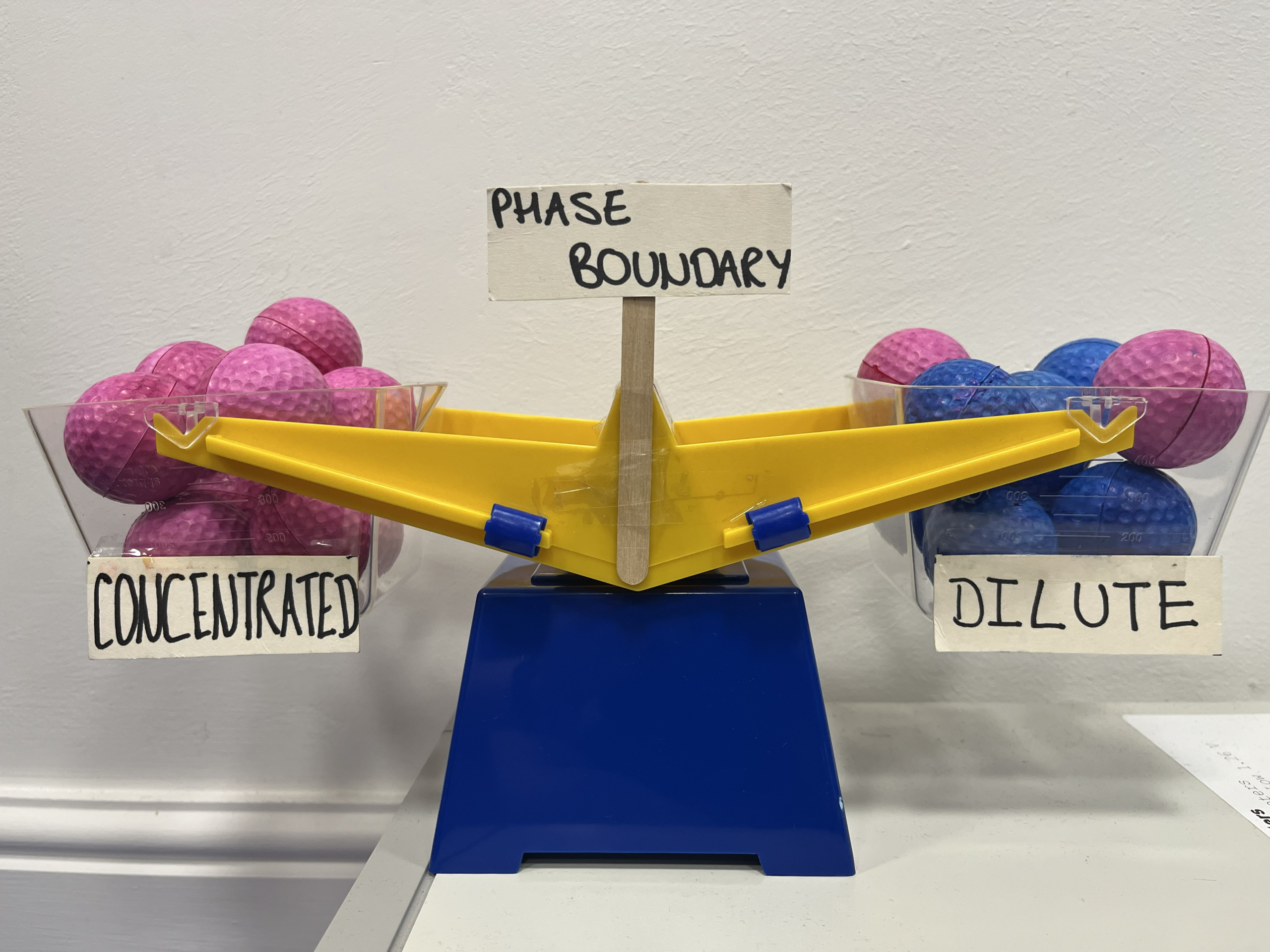
As part of her presentation at the IOP 3MW London and South East heat, Lucy created a weighing scale dilution refrigerator model. The left basket represents a high concentration of helium-3, shown with pink balls, while the right basket represents the diluted phase of helium-4, shown in blue, and helium-3. An audience member, acting as the vacuum pump, removes a helium-3 ball from the diluted basket, causing the scales to become unbalanced. A helium-3 ball then crosses the phase boundary from the concentrated basket to the diluted basket to restore the balance, representing the process that requires heat and helps cool the system.
At a time when succinct soundbites are becoming the way we communicate, the ability to communicate STEM ideas to non-expert, cross sector audiences using inventive, yet clear and credible, ideas has never been so important.
Mark Telling, ISIS Scientist and 3MW co-founder and organiser
Aside from a university module, Lucy had limited experience of science communication before entering the competition. “I thought to myself, it’s only three minutes – what can go wrong?!” she says. On the day, however, the nerves were real. “Before my talk, I was so nervous my hands were shaking. The three minutes were a complete blur, but afterwards I felt so good and everyone was congratulating me on my talk.”
3MW has given Lucy a big confidence boost. She is due to give a presentation to fellow students at the STFC Graduate Conference in July – although, after the strict three-minute format of 3MW, a longer slot brings a different problem. “Ten minutes… I don’t know how I’m going to fill the time!” she jokes.
Lucy says the experience was both interesting and rewarding. “It was a great opportunity to hear about a variety of topics, from biophysics to space science, as well as hearing about other participants’ different career paths.”
For Lucy, the competition also reinforced the importance of science communication. “Especially for early-career people and younger audiences, they might not have heard of any of this before,” she says. “Taking opportunities to explain your work could inspire them into science. People also want to know what researchers are doing, especially when a lot of it is publicly funded. If it seems too complicated, people might wonder why we’re doing it, when in fact it’s important and interesting. Outreach can open people’s horizons.”
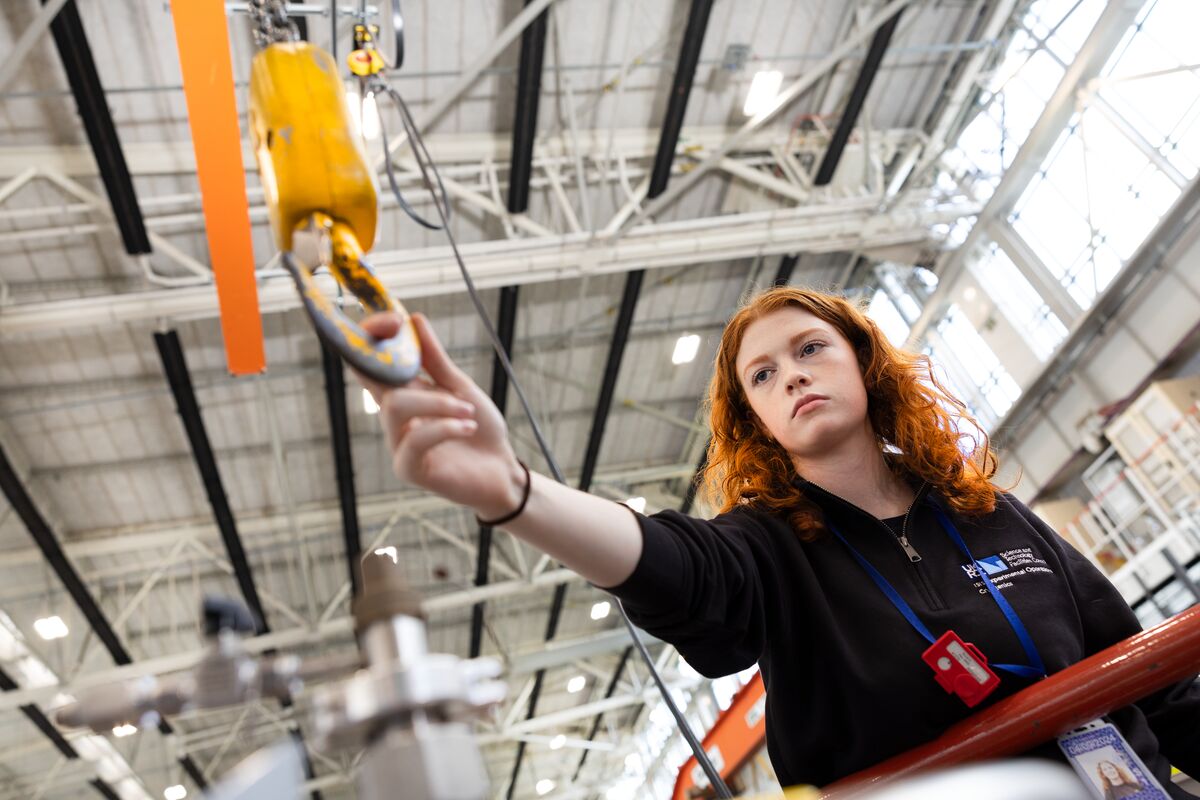
Lucy Bain, Graduate in the ISIS Cryogenics Group, working in Target Station 1.
If you are thinking about participating in 3MW, Lucy would tell you not to hesitate. “I know it can feel really nerve-racking presenting, but Three Minute Wonder is really friendly, with a small number of really supportive participants and judges,” she says. “It’s been really good for practising my presentation skills and it feels very rewarding.”
Her advice for anyone considering entering next year is simple: keep things clear and tell your audience a story. And, of course, bring a prop!
Lucy is continuing her work with the Cryogenics Group, including a project to develop an autofill cryogenic system as part of wider work exploring opportunities to automate traditionally manual tasks. The team hopes to have a prototype by September, and Lucy is currently doing coding work to help improve efficiency.
You can visit the IOP website for more information about the Three Minute Wonder competition, or contact Mark Telling.