
Making plant-based meat alternatives on the beamline to learn how to improve their texture
11 Aug 2026 - Rosie de Laune
Using Larmor as part of the ongoing collaboration between ISIS and the Technical University of Delft, researchers Wim Bouwman and Ekaterina Garina have been studying how the structure of plant proteins develops while they are processed into meat alternatives.

The researchers are working to better understand how the characteristic fibrous structure of soya-based meat alternatives develops during processing. These products are already widely available on the market, but a better understanding of the underlying structuring mechanisms could help guide the design of future products.
The research, carried out with their collaborators Sam Kuijpers and Martijn Gobes from Wageningen University & Research, and with support from beamline scientists Robert Dalgliesh, Gregory Smith and Steven Parnell, is a part of a larger collaboration.
Understanding extrusion
High-moisture extrusion is currently the main technology used to manufacture most plant-based meat alternatives available on supermarket shelves. In previous studies, the team used small-angle neutron scattering (SANS) at ISIS to study a range of samples produced on pilot-scale extrusion lines under different processing conditions. Although these studies provided valuable insights, they could only analyse material after the extrusion process had been stopped, making it impossible to directly observe how the structure developed during processing.
Their latest study, published in Food Hydrocolloids, takes this research a step forward. Using a compact Thermo Fisher Scientific extruder, together with a newly designed neutron-transparent cooling die, the researchers were able to perform in situ SANS, following structure formation while extrusion was still taking place.
The cooling die they have produced is 3D-printed from titanium and contains three neutron-transparent windows positioned along its length. This enabled them to measure the nanometre-scale structure at different locations inside the cooling die, revealing how the material evolves as it flows, cools and solidifies.
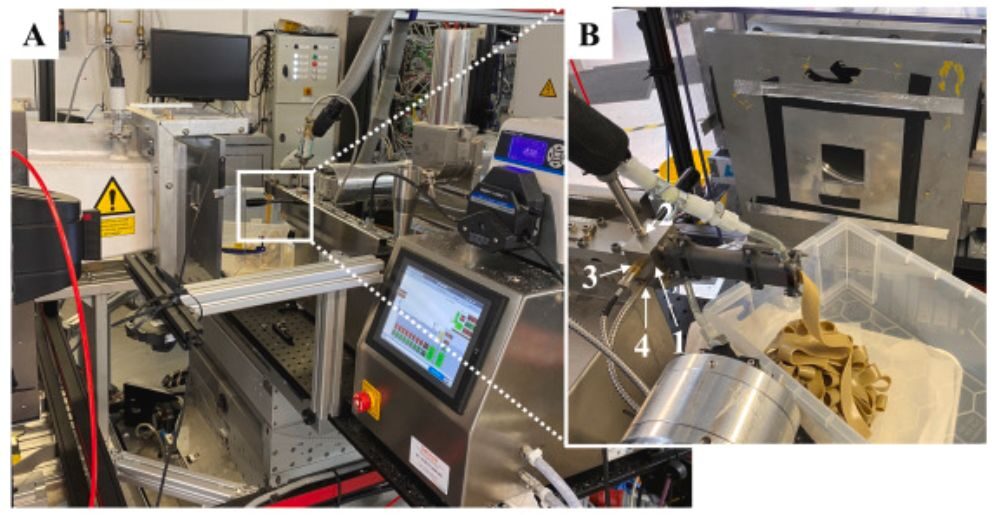
The experimental setup for in situ SANS during extrusion. (A) Process 11 co-rotating twin-screw extruder installed at the Larmor beamline with the custom 3D-printed titanium cooling die positioned in the neutron beam path. (B) Close-up of the outlet region showing: (1) die adaptor that rotates the flow by 90°, (2) pressure sensor, (3) temperature sensor and (4) die adaptor heater.
Building on their previous work showing that pH strongly influences structure formation during extrusion, the team systematically varied the pH of the protein melt using food-grade acids and bases added through the water feed. Even at the macroscopic level, changing the pH produced remarkably different materials, ranging from brittle extrudates to products with a much more pronounced fibrous structure.
Alongside the neutron experiments on Larmor, numerical simulations were used to calculate the flow behaviour inside the cooling die. Combining these simulations with the in situ SANS measurements allowed the researchers to directly relate the local flow conditions inside the die to the nanostructure developing during extrusion, without worrying about structural relaxation during cooling or post-processing.


One of the most exciting aspects of this work was finally being able to observe structure formation while the material was still flowing instead of trying to reconstruct it afterwards from dead-stop experiments.
Ekaterina Garina, TU Delft
Form follows flow
The study shows that protein charge primarily controls how proteins aggregate inside the extruder barrel, while the velocity profile at the entrance of the cooling die determines how these nano-aggregates become aligned. This early nano-scale alignment is subsequently reflected in the macroscopically visible fibrous structure of the final extrudate, providing new insight into hierarchical structure formation during extrusion.
“One of the most exciting aspects of this work was finally being able to observe structure formation while the material was still flowing instead of trying to reconstruct it afterwards from dead-stop experiments,” says Ekaterina Garina, TU Delft. “The next step would be to extend this approach to other legume proteins, which show different aggregation and structuring behaviour compared with soy during their extrusion.”
The full paper can be found at DOI: 10.1016/j.foodhyd.2026.113153