
Staff case study – Samantha Fedorenko
24 Nov 2026 - Rupo Mapanga
Let’s congratulate Samantha Fedorenko, a Mechanical Design and Project Engineer, part of the Sample Environment group in the Design Division of ISIS. She recently gained her chartership from the Institute of Mechanical Engineers – no small feat.

Prior to both this accomplishment and her work at ISIS, a young Samantha would have been found at her all-girls grammar school sitting through her favourite subject, physics. Physics’ scope covers the study of matter, the makings of the universe and behaviour of space and time. It was this that ignited the passion for Samantha – physics’ ability to explain how the world works and the rules that underpins it.
Samantha’s decision to study mechanical engineering at university was guided by educational career talks and engaging design and technology classes. She embarked on her engineering course supported by well wishes from her parents and teachers. This, however, did not prepare her for what she encountered when she entered the lecture hall. She remembers thinking, “woah, everyone is so tall, what’s going on, it was a shock to the system,” after being surrounded by people of her height to suddenly seeing how male-dominated her course was. This didn’t stop her from building strong connections with her cohort.
Samantha’s degree allowed her to discover herself as an engineer and begin her journey to chartership. She started as a student member for the Institute of Mechanical Engineering before starting her journey to chartership as part of her industrial placement year. Her degree also helped her uncover which aspects of engineering she enjoyed most. This turned out to be project management.

Having the control, seeing what’s happening everywhere, seeing all the different cogs and the wheels - that's what ignited my passion for engineering
Samantha Fedorenko
“Having the control, seeing what’s happening everywhere, seeing all the different cogs and the wheels – that’s what ignited my passion for engineering,” described Samantha.
Her newfound interest in project management drew her to the ISIS graduate design engineer role, where she was able to manage projects earlier than she would’ve in comparative roles. During her time in the graduate scheme, she rotated through various design teams working on projects that had different engineering challenges. For example, some materials, when exposed to high temperatures, can soften and become less strong – something Samantha must consider when selecting materials.
Samantha’s experience in the graduate scheme also enabled her to complete key aspects of the necessities for her chartership.
When I left the graduate scheme, I still felt like a newbie, as I hadn’t settled yet
Samantha Fedorenko
“When I left the graduate scheme, I still felt like a newbie, as I hadn’t settled yet,” comments Samantha. However, now she feels more cemented in her role as a mechanical design and project engineer, she can take on long term projects as she is currently doing now creating a cell to aid battery research for the instrument scientists. This project has gifted her the opportunity to learn about new topics like sealing – including the joy that is choosing and designing for O-rings (which thankfully her colleagues can provide guidance on!). With this project on its second iteration, it has allowed her the opportunity to look back on her previous work and solve any prior challenges.
As many can imagine, a great part of an engineering role is seeing ideas conceived in cafes and at the desk becoming tangible. For Samantha this experience is second only to the middle stage of the project where she can finally solve the problem posed by scientists or other engineers and can brainstorm, calculate and create designs in CAD.
English poet William Cowper in ‘The Task’ coined that ‘variety’s the very spice of life,’ well the same applies to Samantha’s work here at ISIS. With her projects having a relatively quick turnaround (6 months to a year) she says that it allows her to have a “fast cycle going from the design phase to here’s my design delivered on the beamline, which is extremely rewarding.”
60 seconds with Samantha Fedorenko
Questions:
- If Samantha wasn’t an engineer, what would she be?
- What is Samantha’s favourite film?
- If Samantha had a time machine, where would she travel back in time to?
- What is Samantha’s favourite book?
- What is Samantha’s favourite food?
- What would Samantha’s superpower be?
- Who is Samantha’s favourite scientist or engineer?
- What is Samantha’s favourite music genre?
- In a film of Samantha’s life, who would she want to play her?
- What is Samantha’s favourite holiday?
Answers:
- As she plays the piano, a music (piano) teacher. Or a geologist, she enjoys the rock side from her treks in the mountains.
- Inside out for its unique concept.
- The early 1900s for the formal fashion and the hats.
- The knife of never letting go by Patrick Ness for the way it illustrates emotions, not solely through written text but also typography, i.e. when the protagonist is overwhelmed, the page has overlapping words in different fonts and size to illustrate this.
- Shepherd’s Pie with an honourable mention to Italian cuisine.
- Staying fit / superstrength.
- Hannah Fry.
- Jazz with fondness for Jamie Cullum and Jacob Collier.
- Helen Mirren.
- The Alps.
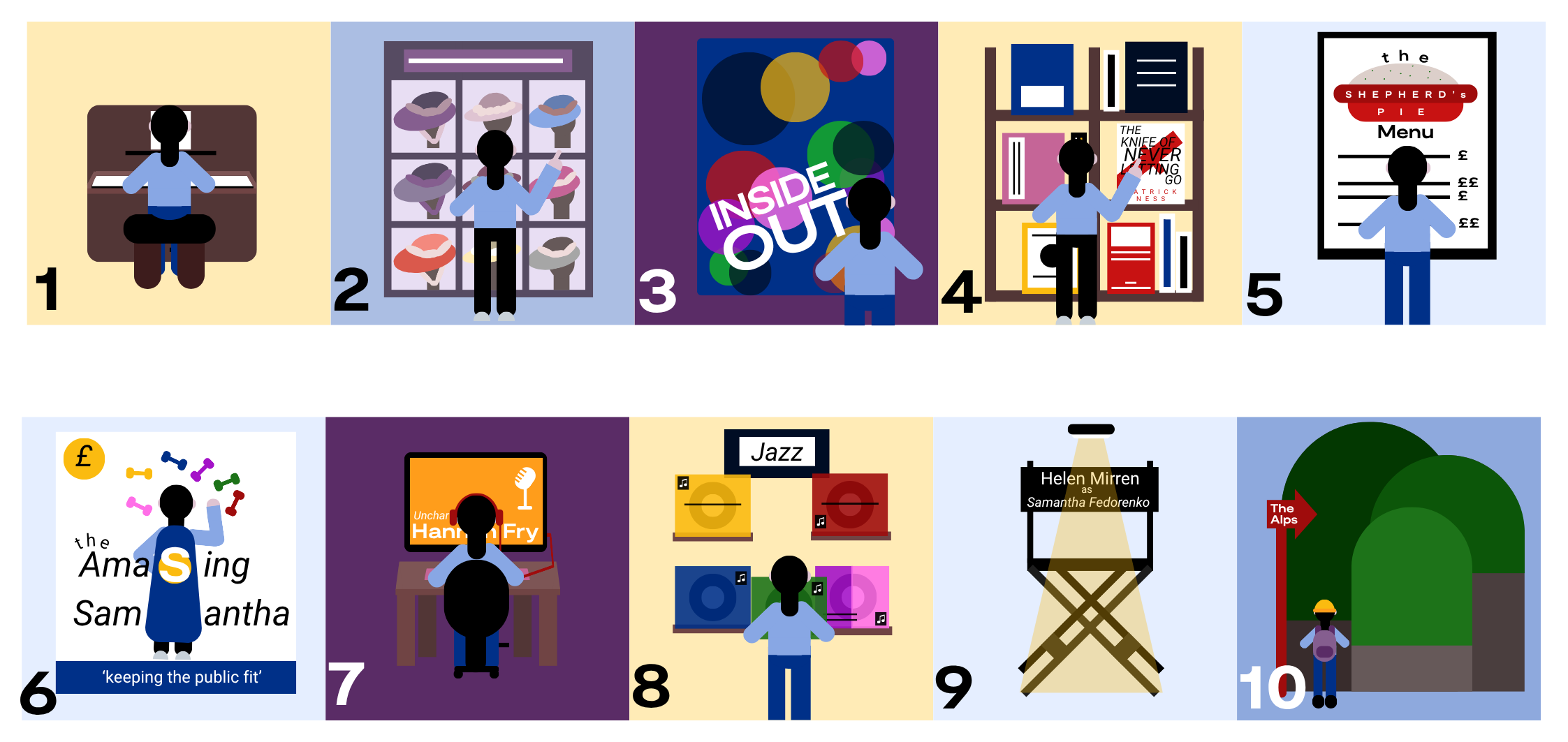
Illustrated graphic of Samantha Fedorenko’s responses to 60 second questions.