
ISIS staff case study: Scott Young
07 May 2026 - Peter Hurrell
Lithium-ion batteries are near-ubiquitous. From mobile phones and laptops to drones and electric vehicles, we rely on electrical power from batteries to power our lives. But they are far from perfect; factors such as extremes of temperature, and accumulated damage over thousands of charging cycles, mean they lose efficiency and have limited lifespans. ISIS instrument scientist Scott Young is unravelling why that happens, and how we can develop new, more efficient batteries in future.

Scott came to ISIS in January 2025, after time spent at UCL and at Dalhousie University in his native Canada. His research is focussed on battery technology thanks to motivation from his early research experiences. “My early mentors were very battery-focussed. Their enthusiasm for batteries and dedication to science in general was contagious,” Scott says.
His academic career began in the lab of Professor Jeff Dahn at Dalhousie, developing positive electrode materials and electrolytes. Batteries contain three main components; a positive electrode, a negative electrode and an electrolyte that enables charge to flow between the electrodes. However, one key factor in battery research is that they are a holistic system – researchers need to understand the whole system to appreciate what’s happening with each element.
The lab regularly collaborated with electric vehicle manufacturer Tesla. That connection enabled Scott to complete an internship at the company to study the composition of battery electrolytes in a highly applied industrial setting. “My previous mentors both had links to industry, but the Tesla internship showed how science can impact industry directly,” Scott says.
Following the internship, Scott moved back to Dalhousie and joined the group of Professor Mark Obrovac. At this point, Scott’s research broadened out to include fundamental studies of battery function. In particular, he studied advanced synthesis of negative electrode materials, showing how researchers could more than double the specific capacity of Li-ion batteries.
A diverse education
In 2021, Scott and his fiancée decided to move to Europe. “I’ve always seen the importance of diversification in terms of education,” says Scott.
They moved to UK, where Scott joined the Electrochemical Innovation Lab at University College London (UCL) to study solid state Li-ion batteries using X-ray computed tomography. Solid state battery technology, which replaces liquid electrolytes with a solid material, is more exploratory than established Li-ion battery technology. Their mechanism is much more complicated, so the research question became, “Why don’t they work consistently?” Scott explains.
Scott’s research focus shifted to focus on characterisation of solid state battery components, and optimising X-ray computed tomography and neutron-computed tomography techniques for battery study. “The two techniques can work better together,” he says. “They’re very complimentary.”
From first beamtime to a new technique
It was during this period that Scott experienced his first beamtime at a large-scale facility. “My first ever beamtime was at Diamond in 2022. That was my first exposure to a synchrotron. I was inspired, and still excited… to this day.”
His move to ISIS in 2025 was supported by an International Science Partnerships Fund (ISPF)-funded fellowship. ISPF recognises the importance of international collaboration to tackle shared global research and innovation challenges. For Scott, that means he needs to consider the interests of all partner facilities – ISIS, PSI, and Diamond. “I work closely with collaborators at PSI to advance neutron imaging techniques for both facilities,” he adds.
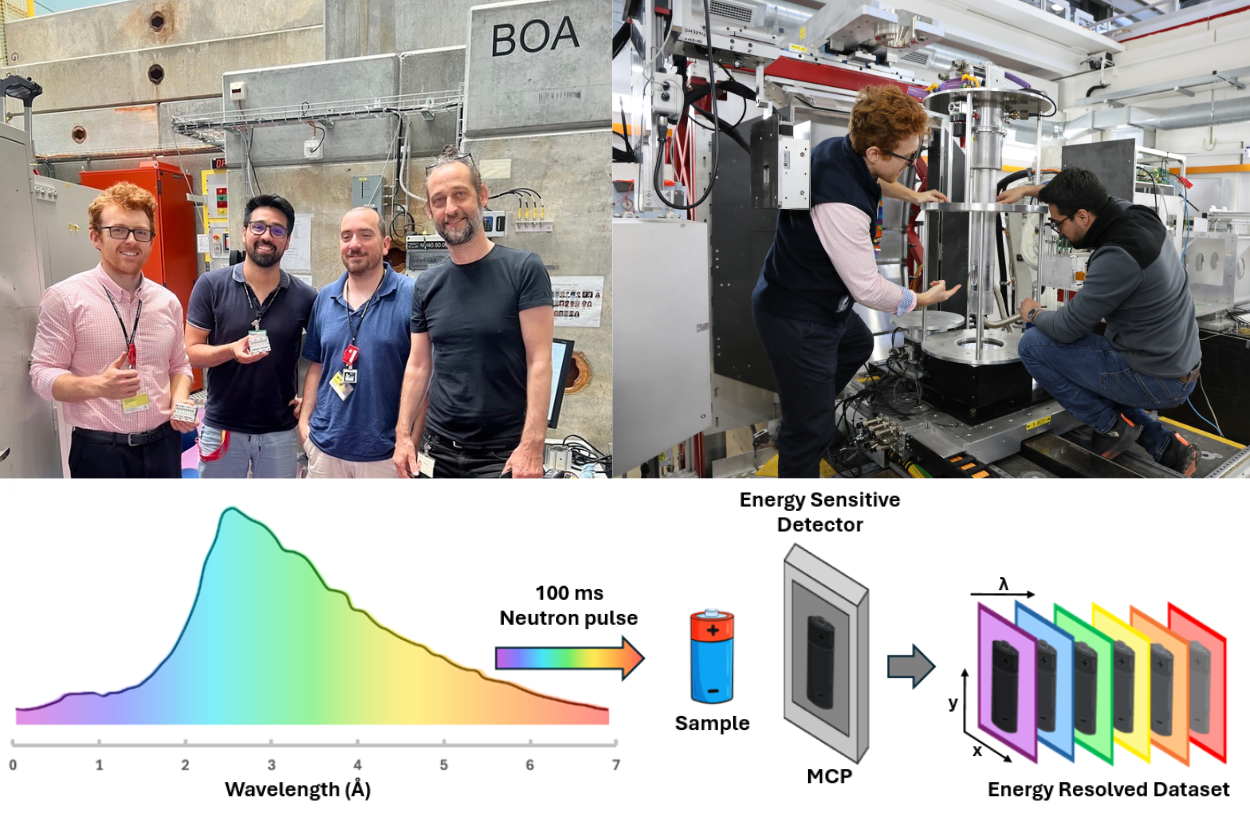
Top left: Scott and collaborators at PSI. Top right: Scott and Ricardo on IMAT. Bottom: Schematic of SNI technique.
At ISIS, Scott is focussed on neutron imaging on the IMAT instrument. Neutron imaging enables researchers to see inside objects and materials, similar to how X-ray imaging works. However, neutrons interact with the atomic nucleus, meaning they are sensitive to different elements than X-rays. Neutrons are also non-destructive and can penetrate far into materials, enabling Scott to image battery cells during operation or under harsh conditions such as extreme cold. The resulting images will highlight areas of electrolyte depletion and damage inside the battery cells and could lead to new and improved battery designs.
Scott is also developing a novel neutron technique called spectroscopic neutron imaging (SNI). The technique, which is in the process of being published, is a new form of neutron imaging that allows scientists to squeeze more information from the neutron beam and can identify the chemical species present in a sample.
Enthusiasm shared
Alongside the lab work, Scott is keen to communicate his research to a much broader audience.
He runs a Youtube channel called XCT Chaps with fellow researcher Francesco Iacoviello. On it, they publish informal lectures, experiments and behind the scenes glimpses into the world of imaging. Scott is also an enthusiastic ISIS tour guide, leading groups of researchers from industry and academia, as well as less technical audiences such as school children. “It’s great to share my enthusiasm with all sorts of people, and get them as excited for science as I am,” he says.
For now, Scott is focussed on publishing the results of the past year’s work at ISIS. After that, “I want to apply large scale facility techniques to solving some of the most complicated battery problems,” Scott adds.