Continuing to reduce ISIS energy use through a further RF upgrade
10 Nov 2026 - Rosie de Laune
A project to update the radio frequency cavities in the synchrotron is now complete. In the ISIS synchrotron, the protons are accelerated using radio frequency (RF) cavities. Six of these, the fundamental cavities, produce the overall 'strength' of the voltage, with the remaining four modifying the 'shape' of the voltage to maximise the total number of protons that can be stably contained within the synchrotron.

These systems were installed when ISIS was first built and at their core are thermionic valves known as tetrodes. The tetrodes used at ISIS were ‘4648 tetrodes’: a design that is now so rare that there is just one supplier based in the USA, with ISIS being the only user. As the team needed to replace three or four tetrodes each year, the costs and logistics of re-supply were becoming unsustainable.
During the ISIS long shutdown in 2021, the tetrodes in the six fundamental RF systems were replaced with TH558 tetrodes, which are much more common not only in other proton synchrotrons but also in the broadcast industry. This upgrade not only resolved the concerns around supply, but also led to a power saving of 38%.
Now, the team has completed the second stage of this project: replacing the second harmonic RF systems.
The second Harmonic RF High Power Drives were replaced with the same tetrodes as the fundamental drives, which makes maintaining them a lot simpler and is an improvement on needing two different parts for the different systems. The upgrade has reduced the power consumption of the synchrotron RF system by an estimated 800 kW. In total, the energy savings of the project will reduce the cost of running the synchrotron by around one million pounds a year.

This gives us the luxury of having first-hand knowledge of failure mechanisms and annoyances in current designs which we can design out of the new systems.
Neil Farthing
Most of the parts required for this upgrade were designed and built in house by the ISIS RF section. “This gives us the luxury of having first-hand knowledge of failure mechanisms and annoyances in current designs which we can design out of new systems,” explains Neil Farthing. “This makes life easier for ourselves when we have to work on them – particularly during a night-time callout!”
During the October/November 2024 shutdown, one of the Second Harmonic RF systems was stripped out and refitted with the new system. This was commissioned and is now fully operating.
In 2025, the final two Second Harmonic systems were upgraded and the project is now closed out on time and on budget. This marks the completion of this series of upgrades.
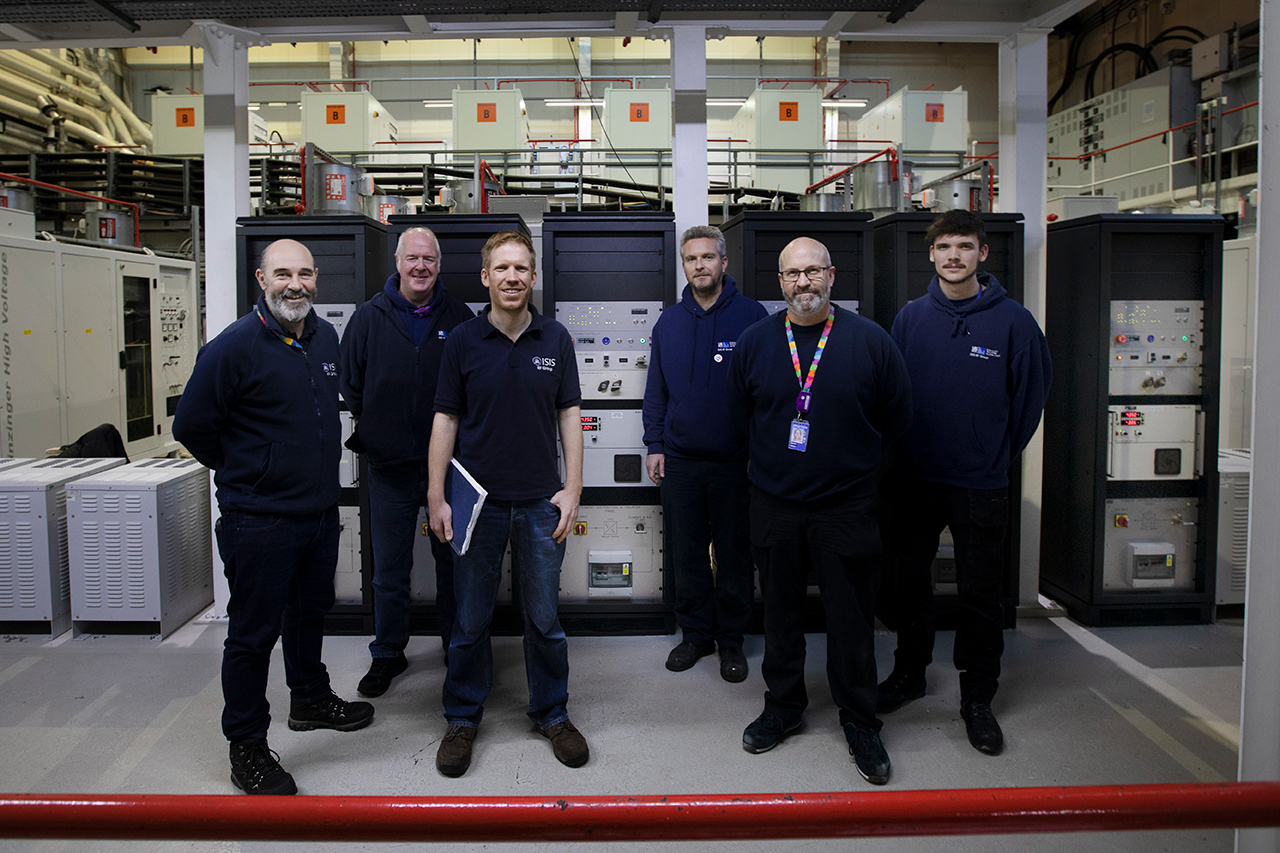
Andy Seville, Dave Allen, Rob Mathieson, Neil Farthing, Dave Gibbs, Ryan Allinson (Left to Right) in front of the new control racks.
As well as these high-power RF systems, which act as the muscles of the synchrotron, the team have also been working on the low-level RF system, effectively the brain that controls them. As with a lot of the synchrotron controls, they have been in place since ISIS was built in the 1980s, and this project has enabled the team to set them up in a way that makes them able to run more intelligently. This also contributes to the reduction in energy consumption, as it enables the main control room and machine physicists to adapt the synchrotron to operate differently under different conditions.
Contact: de Laune, Rosie (STFC,RAL,ISIS)