
Deuteration Facility
The ISIS Deuteration Facility supplies deuterated compounds and precursors to the UK Neutron community to support scientific research at ISIS or other neutron facilities across the world.

Overview
Deuteration is a powerful tool for neutron scattering experiments due to the fact that neutrons are highly sensitive to hydrogen. Replacing hydrogen atoms with deuterium can significantly reduce background scattering and absorption, while also enhancing contrast between different components of a sample. This allows researchers to selectively highlight specific regions of complex systems, improve data quality, and obtain structural and dynamical information that may be inaccessible using non-deuterated materials. Deuteration is widely used across soft matter, biological, chemical, and materials science research to maximise the information obtainable from neutron experiments.
The ISIS Deuteration Laboratory provides expertise and facilities to produce deuterated molecules and materials tailored to the requirements of neutron scattering experiments.
Contacts
ISIS Deuteration Facility Team - ISISDeuterationFacility@stfc.ac.uk

James Tellam
Deuteration Facility Senior Chemist
June McCorquodale
Deuteration Facility Operations Manager
Kun Ma
Deuteration Facility Synthetic Chemist
Peixun Li
Science Lead
Yao Chen
Deuteration Facility Synthetic Chemist
Capabilities and Expertise
The ISIS Deuteration Facility specialises in chemical deuteration, supporting a wide range of research areas including advanced materials, energy, life sciences, and neutron scattering techniques such as small-angle neutron scattering (SANS), reflectometry, and studies of disordered materials. Current capabilities include the synthesis of surfactants, ionic liquids, ligands, monomers, and battery solvents, although this list is continually expanding.
Our current catalogue of deuterated compounds is available to view in this pdf document. Please note that this catalogue is not exhaustive, and we increasingly deliver bespoke deuterated compounds tailored to the requirements of individual research projects. If your desired compound is not listed, please contact the Deuteration Facility to discuss your specific requirements.
In addition to material synthesis, the facility provides expertise and training in deuteration chemistry. We regularly host researchers, including PhD students and postgraduate researchers, who use our laboratories to synthesise requested compounds, develop new deuteration methodologies, or gain practical experience in isotope-labelling techniques. We also welcome independent researchers undertaking longer-term projects and frequently collaborate with Principal Investigators through joint supervision of students and research programmes. Guidance on sourcing commercially available deuterated materials is also available where appropriate.
Accessing the ISIS Deuteration Facility
Requests for deuterated materials to support ISIS neutron experiments should be submitted through the ISIS Direct Access Route as part of a beamtime proposal. However, prospective users are strongly encouraged to contact the ISIS Deuteration Facility before submitting a proposal to discuss their requirements and assess the feasibility of the requested synthesis.
All requests are initially reviewed by the ISIS Deuteration Facility Access Panel (FAP), which assesses the technical feasibility, resource requirements, and timescales associated with the proposed work. This assessment is then provided to the relevant ISIS Science Group and considered alongside the standard peer-review process for beamtime allocation.
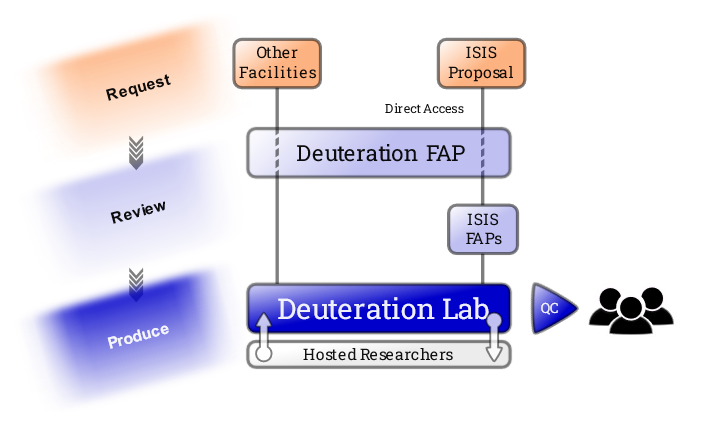
Applicants whose requests are approved will receive a formal notification from the Deuteration Management Team outlining the next steps and any additional requirements.
UK-based users requiring deuterated materials for experiments at neutron facilities other than ISIS may also apply for support through a dedicated access route. Further details and application information can be found via the linked application form.
Further Guidance
Requests are assigned a feasibility rating based on the complexity, risk, and expected synthesis effort associated with producing the material:
- Category 1: Material is in stock or is consistently produced and can be provided for your experiment.
- Category 2: Material has been produced previously using an established method.
- Category 3: Material has not been produced routinely; however, a known method exists.
- Category 4: Material has never been produced but a feasible synthesis route has been identified, therefore has a high chance of success.
- Category 5: Material has never been produced and requires research and development, therefore is high risk, but provides a good scientific opportunity.
- Category 6: It is currently unfeasible for the facility to produce this material. We recommend contacting other deuteration facilities (The Deuteration Network: DEUNET).
- Category 7: Recommend to purchase from commercial suppliers.
As with all synthetic chemistry, there is an inherent element of risk. While the ISIS Deuteration Facility will make every reasonable effort to deliver requested materials within agreed timescales, successful synthesis and delivery cannot be guaranteed.
Materials supplied by the ISIS Deuteration Facility are provided solely for use in approved neutron scattering experiments and associated measurements. Use of these materials is restricted to the requesting research team, and any third-party use must be agreed with the facility in advance.
For bespoke compounds produced through custom synthesis, users are expected to complete experimental work and publish resulting outputs within three years of material delivery. After this period, the ISIS Deuteration Facility reserves the right to make these materials available to other users.
Due to the cost and high demand of deuterated materials, it is important to ensure any unused material is sent back to the ISIS Deuteration Facility. There may also be options to recycle material that has been used in an experiment, please contact the ISIS Deuteration Facility to discuss options.
Publication Policy
The ISIS Deuteration Facility relies on publications to demonstrate the scientific impact of the materials, expertise, and support provided to users. We therefore ask that all publications arising from the use of deuterated materials supplied by the facility appropriately acknowledge our contribution.
The appropriate level of recognition will depend on the nature of the support provided. Co-authorship is expected where significant intellectual input, method development, custom synthesis, experimental design, or data interpretation has been provided. These arrangements should be discussed with the facility at an early stage of the project and before delivery of the requested material.
Users are requested to inform the facility of any publications resulting from the use of deuterated materials supplied by the ISIS Deuteration Facility. Further information can be found in the ISIS Publication Policy.