Elemental analysis
Elemental analysis technique is used to determine, qualitatively and/or quantitatively, the elemental/isotopic composition and spatial 2D/3D distribution in any material.
The material in question can range from archaeological and historical artefacts to modern-day battery materials.
Different elemental analysis techniques, both destructive and non-destructive, have been developed over the years each with their own set of advantages and limitations. The ISIS Neutron and Muon Source uses neutrons and muons to carry out this technique in a non-destructive manner.

Elemental analysis using negative muons
(i) Using energy of muonic X-rays (MuX instrument)
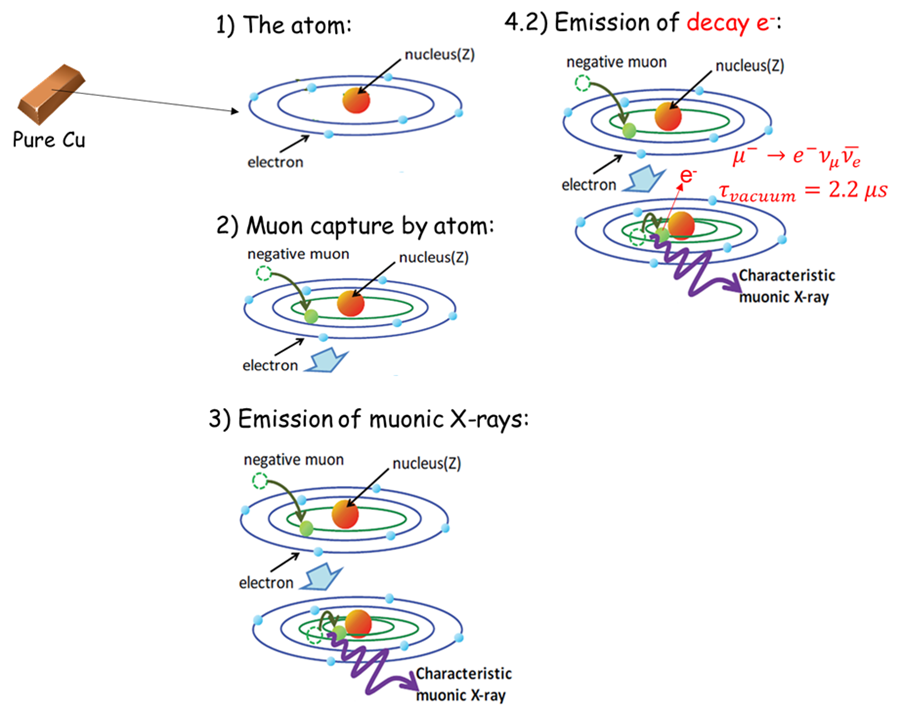
When a negative muon beam of particular energy is bombarded on a sample, it is captured by the atoms of the different elements, at a particular depth inside the sample, forming muonic atoms. These muonic atoms emit characteristic muonic X-rays, which are then detected by the detectors placed around the sample generating an energy spectrum.
The area under a peak corresponding to a particular element is proportional to the amount of the element/isotope present in the sample. By changing the energy of the muons, once can probe the elemental/isotopic composition at different depths inside the sample.
(ii) Using lifetime of muon decay (ARGUS instrument)
The physics process is the same as above, but instead of detecting the muonic X-rays, we detect the electrons that are emitted during the muon decay in the muonic atom. The average lifetime of muon decay in vacuum is 2.2 μs.
However, this value is smaller when the muon decay occurs inside a material, and it has a characteristic value for each element/isotope. This method also allows the determination of elemental/isotopic composition at different depths inside the sample.
Elemental analysis using neutrons
1) Neutron Resonance Transmission Imaging (NRTI)
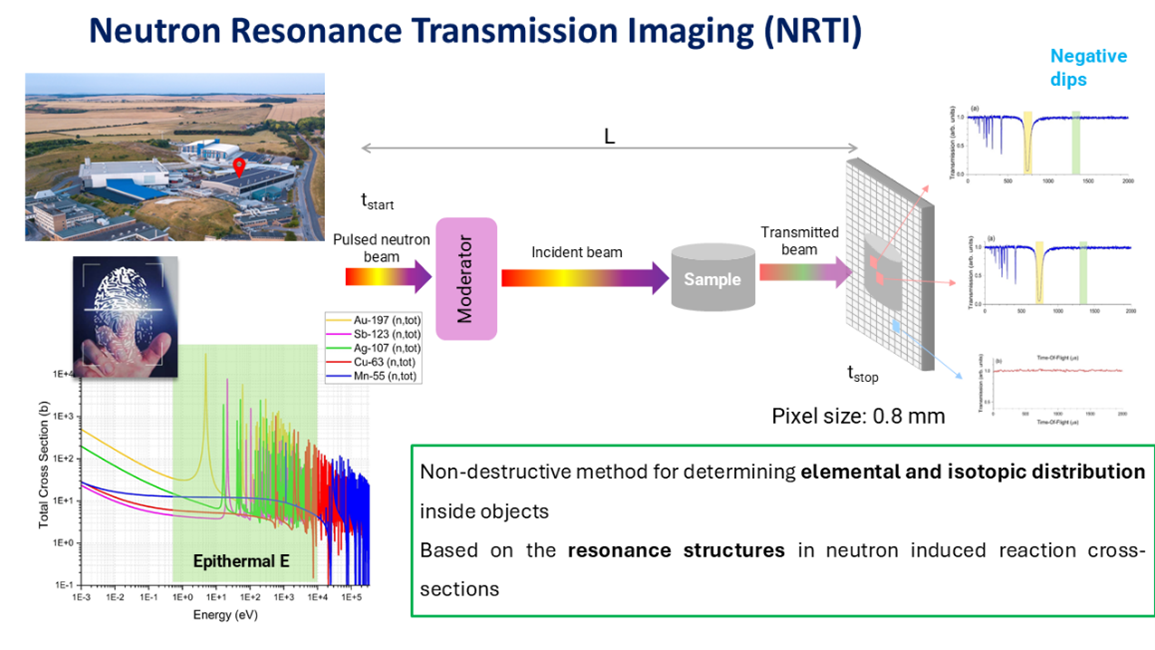 NRTI is a non-destructive energy selective imaging technique, available at the INES (Italian Neutron Experimental Station) instrument, suitable for the characterization in terms of elements and isotopes amount and distribution of large inhomogeneous samples. The NRTI technique is based on the presence of resonance structures in the neutron-induced reaction cross-sections for specific energies, that are effectively fingerprints of elements and isotopes. NRTI provides 2D/3D maps of isotopes and elements within the analysed sample.
2) Prompt Gamma Ray spectroscopy (NRCA and PGAA)
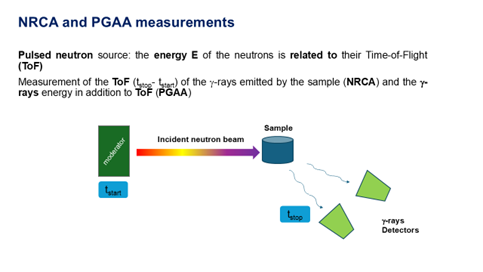 NRCA (Neutron Resonance Capture Analysis) and PGAA (Prompt Gamma Activation Analysis) are techniques that allow for the element/isotope bulk composition of samples. They rely on the capture of neutron of specific energy, and the consequent gamma ray emission following the compound nucleus de-excitation. NRCA is based on ToF measurements of the gamma-rays following a resonant neutron capture, that directly provide the “fingerprint” of elements and isotopes in the samples. PGAA in addition provides the gamma-rays energy, not only the ToF of the gamma-rays emitted, for higher accuracy and sensitivity.
3) Delayed Gamma Rays spectroscopy (NAA)
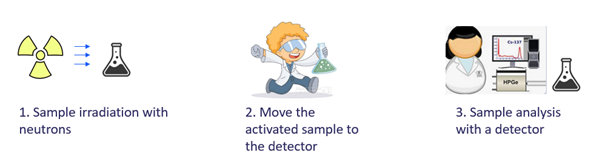 Neutron Activation Analysis (NAA) is the most traditional of these techniques for elemental analysis. It separates the phase of irradiation of the sample, and the phase of gamma spectroscopy measurement. By doing this one can perform the gamma spectroscopy in shielded locations where the background is very low and therefore achieve remarkable sensitivities, down to ppm in many cases. A good number of elements are measurable with this techniques, with different sensitivities according to the cross section.
Some elements are not measurable, in particular light elements, for which one might want to use the more challenging PGAA. For this reason, researchers need to choose the right techniques according to the elements under study. At ISIS, NAA is usually performed by doing irradiation with the water-moderated beam of the Ines beamline, and using the Germanium detectors of the irradiation group at ChipIR.