
Small-angle neutron scattering
Small-angle neutron scattering (SANS) is a technique for examining bulk materials at length scales ranging from 0.5 nanometres to several hundred nanometres.
It is used to investigate a very wide range of materials in soft-matter, bioscience, hard condensed matter and engineering. This includes, proteins, polymers, magnetic nanoparticles, superconductors, microemulsions, steels, liposomes, and materials for cosmetics, drug delivery and food science.
Additionally, the spin-echo SANS technique available on the Larmor instrument extends the measurable length scales from nanometres to micrometres.

Additional information
Specification of quartz cells used for SANS
We recommend you to bring your own cuvettes, but we also have some units for loan. Please talk to the instrument scientist to reserve these parts for your experiment.
| Article No | Mat. Code | Wavelength Range | Optical Path Length | Volume |
| 404-2-46 | QX | 200 nm-3500 nm | 2 mm | 1400 µl |
| 404-1-46 | QX | 200 nm-3500 nm | 1 mm | 700 µl |
| 100-1-40 | QS | 200 nm-2500 nm | 1 mm | 350 µl |
| 100-2-40 | QS | 200 nm-2500 nm | 2 mm | 700 µl |
| 110-1-40 | QS | 200 nm-2500 nm | 1 mm | 350 µl |
| 110-2-40 | QS | 200 nm-2500 nm | 2 mm | 700 µl |
| 120-000-1-40 | QS | 200 nm-2500 nm | 1 mm | 280 µl |
| 120-000-2-40 | QS | 200 nm-2500 nm | 2 mm | 560 µl |
ISIS does not endorse any particular manufacturer of quartz cuvettes but both Hellma (stock codes: 110, 120 & 404; material codes: QS/QX) and Optiglass (stock codes: 21 & 32; material code: Q) manufacture suitable products.
Alternative cuvettes for gel samples:
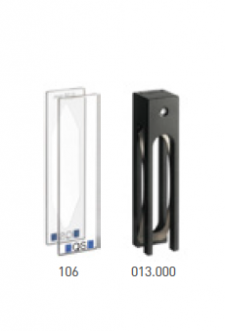
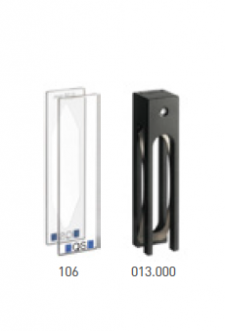
Demountable cells with small volume: Quartz plates of 40mm x 10mm, with thickness of 1mm or less. The sample goes in between the two plates and is clamped with the black part shown on the right in the image below. We recommend you to bring your own cuvettes, but we also have some units for loan (very few). Please talk to the instrument scientist to reserve these parts for your experiment.
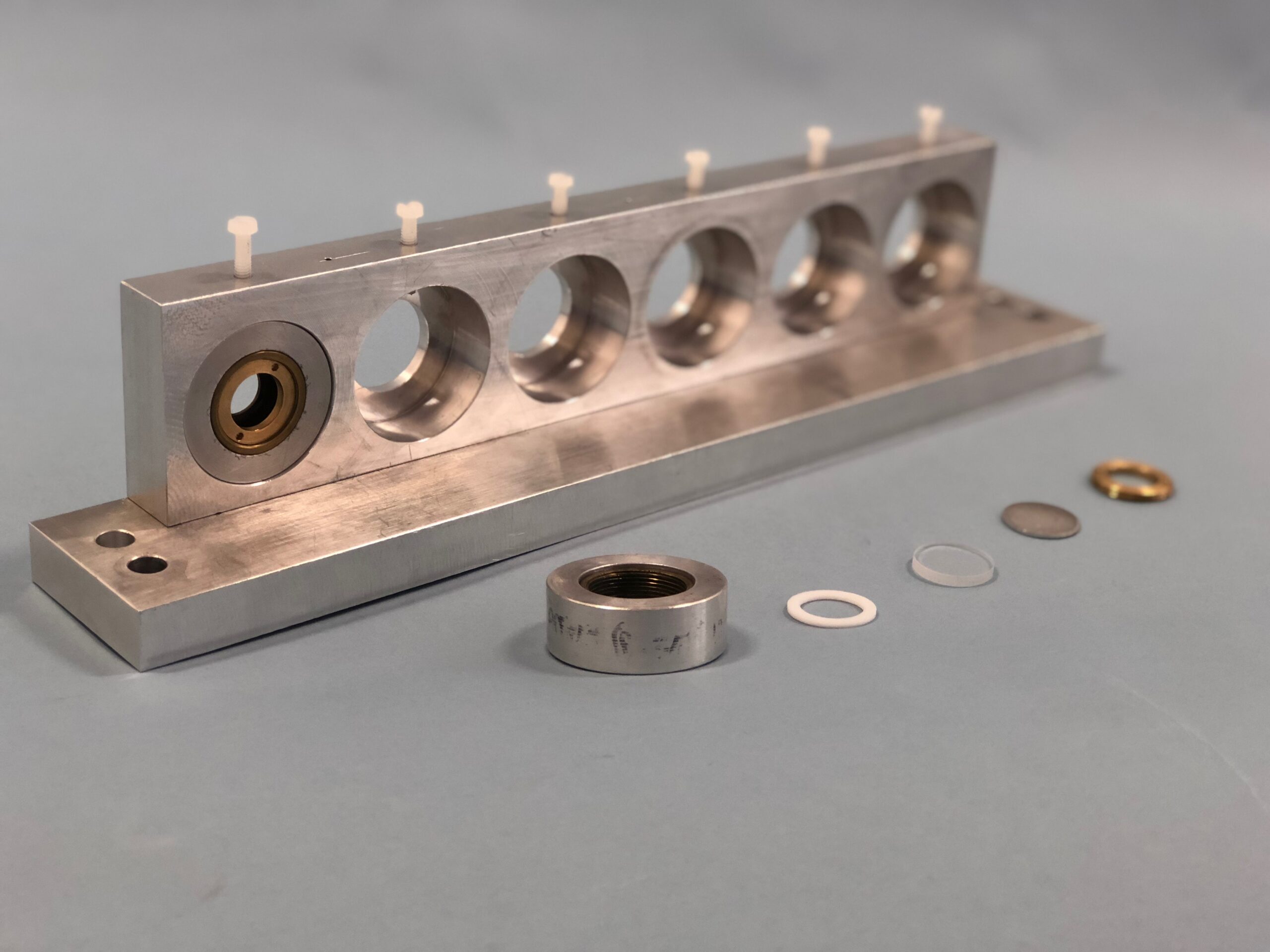
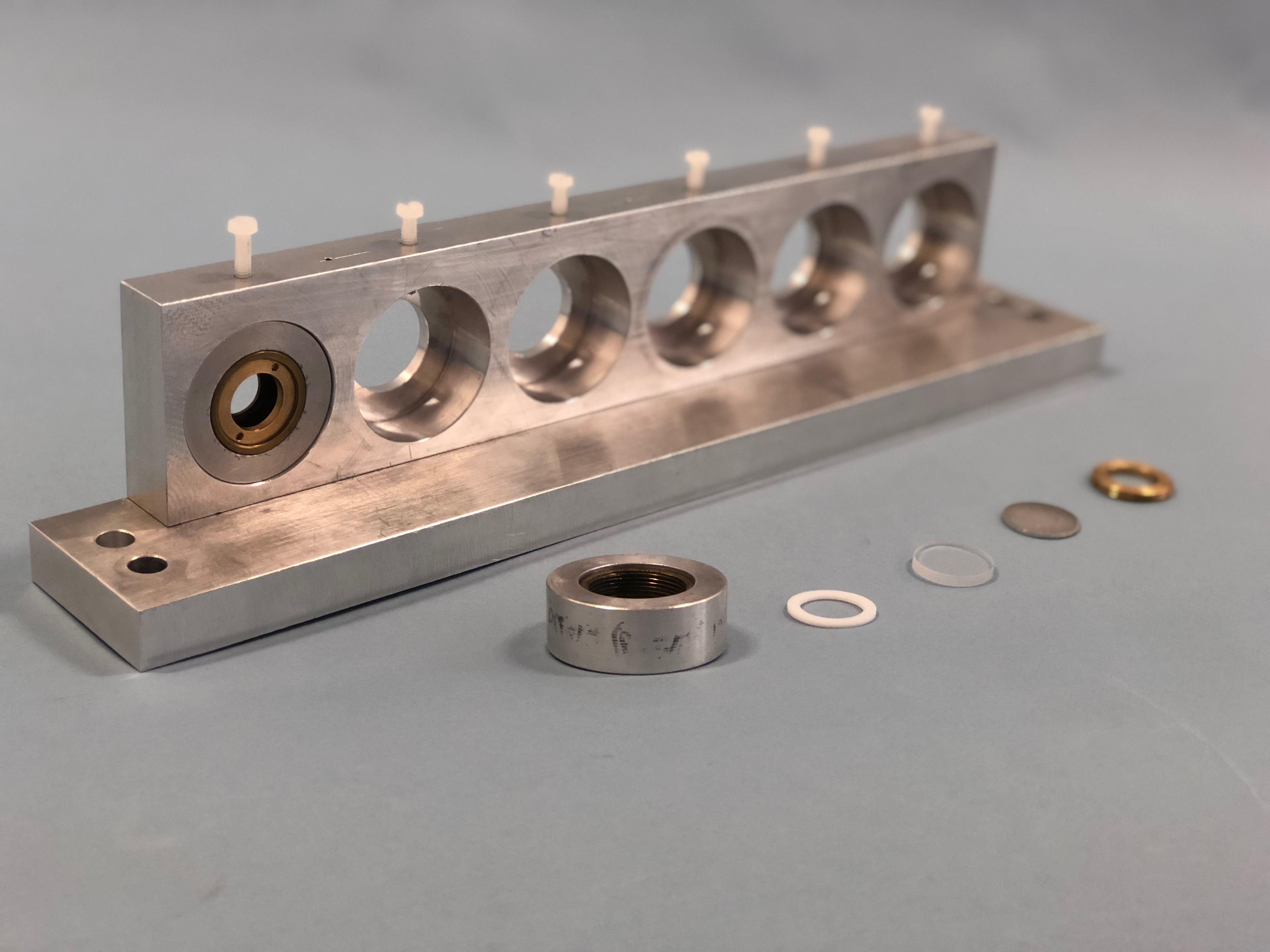
 Durham Gel Cell: Aluminium pods of 15 mm diameter, holding two quartz disks separated by a Teflon spacer of 1 mm or less. The gel sample goes in between the two quartz disks and the ensemble is tightened with a screw. We recommend you to bring your own quartz disks, but we also have some units for loan. Please talk to the instrument scientist to reserve these parts for your experiment.
Q range for SANS suite instruments
When choosing your Q range, think also about flux and statistics. Since the neutron flux decays with the inverse of the square of the distance, it will be 9 times higher using 4 m sample-detector-distance setup, comparing with 12 m setup. Additionally, at 12 m setup, we have to use a narrower wavelength range in time of flight mode, which will decrease statistics at low Q. This will be more important for weakly scattering samples.
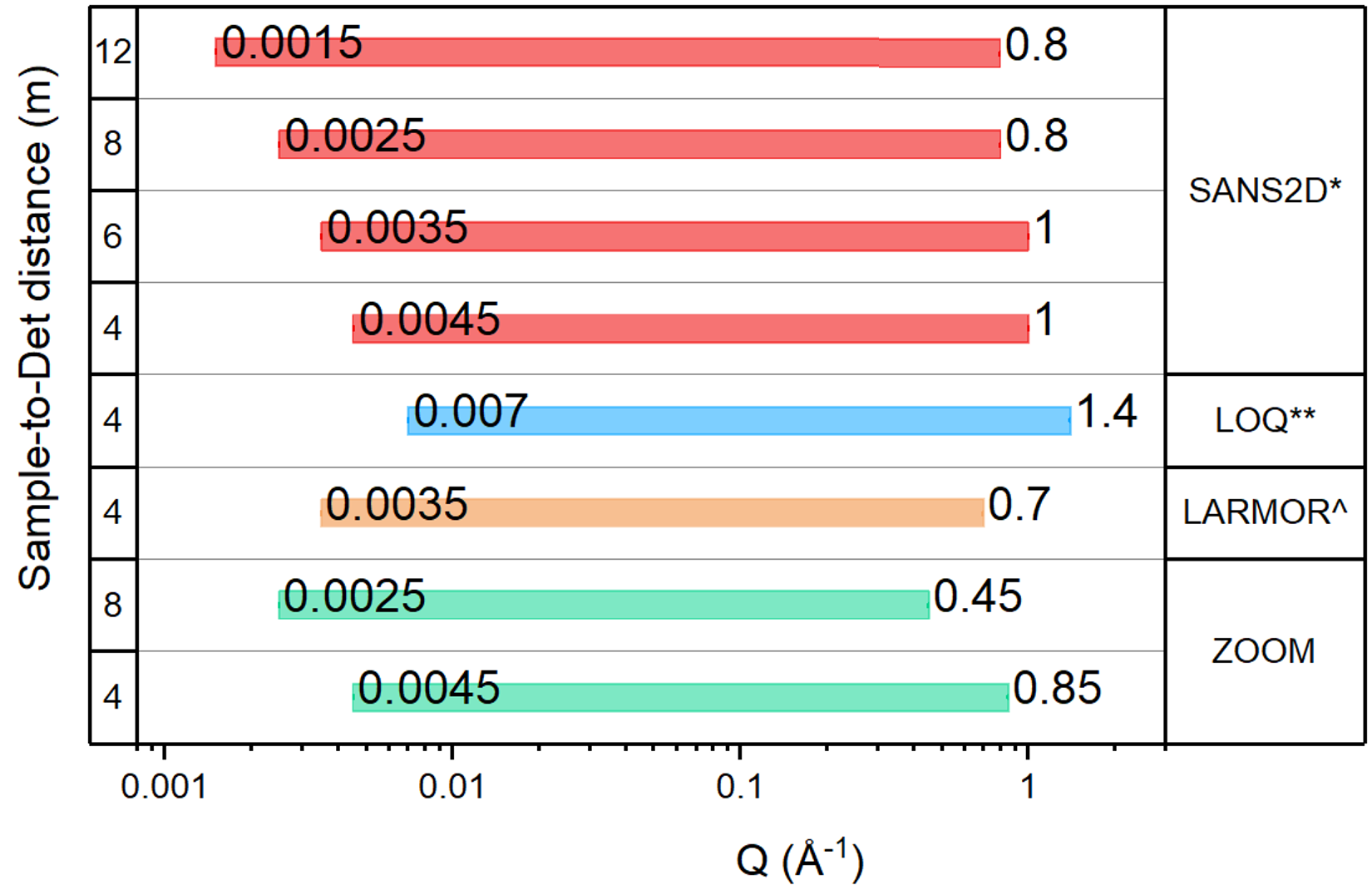
*/** Merging low and high angle bank; ^extended Qmax up to 1 Å-1, using offset det (other scales can be probed by using SESANS).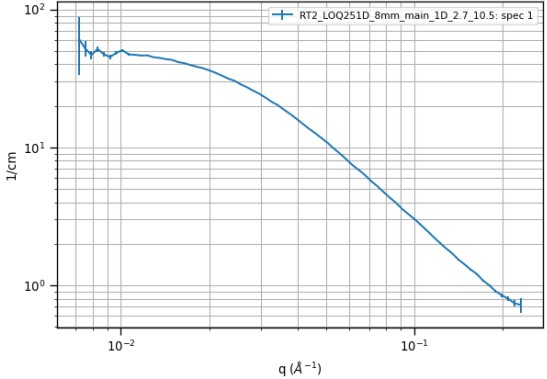
Soft-matter sample environment support
The complexity and variety of samples used in soft matter research demand special requirements from the design and operation of sample environment equipment. ISIS has recently set up a Soft Matter Team in the Sample Environment Group. More about their work can be found on the Sample Environment page.
SANS data reduction and analysis
Ada is a virtual computing environment maintained by STFC where you can use software for data reduction (e.g. Mantid) and data analysis (e.g. SasView).
Once you have finished your experiments, you can download the files you have created:
Processed Data
This may be data you and/or your Local Contact have reduced in Mantid, or output files from analyses performed in SasView and other data analysis programs, or other ancillary files associated with the experiment (such as images, videos, sample environment output files, etc). The files may have been created on computers on the beamline or using Ada.
All of these files can be accessed via the ISIS Remote Data Access gateway.
Any designated participant in an experiment may upload files to, or download files from, a folder under
/INSTRUMENT/<instrument_name>/RBnumber/RBnnnnnnn
This is the same location that may be accessed with the ‘RB Directories’ shortcut on the IDAaaS desktop, or through the /INSTRUMENT/<instrument_name>/CYCLExxxxx/RBnnnnnnn shortcut in the Remote Data Access gateway. DO NOT try uploading files to /INSTRUMENT/<instrument_name>/CYCLExxxxx/RBnnnnnnn!!!
Files placed/created in /INSTRUMENT/<instrument_name>/RBnumber/RBnnnnnnn remain there until deleted but they are not archived or backed up. Please note: deleted files cannot be recovered!
Files stored locally on instrument computers will first need to be pushed to the required /INSTRUMENT/<instrument_name>/RBnumber/RBnnnnnnn folder. Ask your Local Contact to do this.
There is currently no limit on the size of file that can be uploaded, but there is a 5Gb limit on the size of file that can be downloaded.
NB: Raw data in Ada is stored under /ARCHIVE, not /INSTRUMENT, and so raw data is not visible to the Remote Data Access gateway. However, the raw data may be downloaded as a zip file either by clicking on ‘Experiments’ and selecting the required experiment (this will also provide your data DOI if one has been assigned), or by logging in to the Data Catalogue (see Raw Data below).
Raw Data
This is the un-reduced, as-collected, time-of-flight neutron data. Although the files can be inspected by any HDF5-compliant application, you can only process your raw SANS data in Mantid. You may want your raw data if you intend to perform data reduction on one of your own computers, and/or wish to keep your own data archive. NB: All ISIS Raw Data is automatically archived. There is no requirement for you to keep your own archive.
Raw data can be accessed via the ISIS Neutron and Muon Source Data Catalogue.
- Navigate to the RB number of your experiment or use the search filters.
- Click on the title of your required experiment
- Click the Download button on the right.
- Clicking on the ‘i’ on the left brings up some more details about the experiment, including the data DOI if one has been assigned.
Mantid
This video tutorial describes how to use Mantid to reduce data from all ISIS SANS instruments: LOQ, SANS2D, Larmor and Zoom.
Click here to download SasView and view several TUTORIALS on how to use it for data analysis. Click here for fitting models. Additional fitting models can also be downloaded (free of charge) from the SasView Model Marketplace.