
Neutrons reveal quantum liquid of octupoles
27 Mar 2020 - Rosie de Laune
Experiments on MAPS, MERLIN and GEM have identified a quantum liquid of magnetic octupoles formed by a cerium-based compound. In a quantum spin liquid, the magnetic moments of the material are correlated but remain disordered and fluctuating even at absolute zero. Materials that can form a quantum spin liquid offer insights into exotic emergent properties, where the behaviour of a system does not depend on its individual parts, but on their relationships to one another.

These insights can, in turn, lead to an enhanced understanding of the phenomena that might one day have applications in quantum computing, data storage and high temperature superconductivity.
Many quantum spin liquids are based on a structure where the magnetic dipoles of the atoms are positioned in such a way that it is not possible for each dipole to align with its neighbours in a way that would be most favourable, given the interactions between them. A classic example of such a ‘frustrated’ system is when moments on points of a triangle have interactions that favour their neighbours to be aligned in opposite directions. Although two moments can do this, the third is always frustrated (see below).
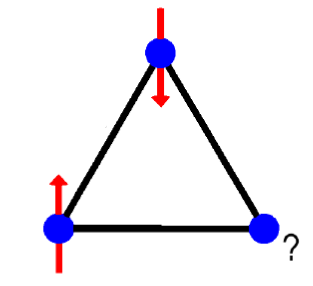
Diagram of a triangular lattice indicating frustration due to the inability to align oppositely to both neighbours.
Even at temperatures approaching absolute zero, magnetic frustration can prevent the magnetic moments arranging themselves into an ordered pattern, even if the interactions between them are very strong. At these low temperatures, quantum fluctuations, which are intrinsic to the material, start to become more important than the thermal fluctuations (the magnetic moments moving around due to having thermal energy). Understanding the nature, and implications, of the quantum fluctuations remains an outstanding challenge in modern condensed matter physics.
For compounds based on heavier elements with unpaired electrons in their f-orbitals, the atoms can carry more degrees of freedom than those associated with magnetic dipoles. A recent study, published in Nature Physics this week, reports the discovery of a quantum spin liquid formed of magnetic octupoles in the material Ce2Sn2O7.
Using a variety of neutron scattering experiments on MAPS, MERLIN and GEM at ISIS, and other instruments based at PSI and the ILL, the international group of researchers were able to confirm this remarkable discovery, and how it was consistent with a well-established theoretical model.
In the state of Ce2Sn2O7 formed, there are both interactions between the magnetic octupoles, and weaker interactions between magnetic dipoles. The combination of these results in an octupolar quantum spin liquid. Ce2Sn2O7 is the first example of a material that forms a phase like this, as opposed to a dipolar spin liquid, and the neutron scattering measurements were critical in establishing this.
Additionally, the group demonstrated that the degrees of freedom in the octupole ice are quantum objects whose dual dipole–octupole nature can be controlled using changing temperature, which gives interesting perspectives in the field of quantum many-body systems and future related technologies.
Further information
The full paper can be found online at: https://www.nature.com/articles/s41567-020-0827-7; or accessed for free via ReadCube: https://rdcu.be/b3bN6.
PSI have also featured this work on their website, accessible through this link: https://www.psi.ch/en/num/featured/spin-ice-expands-to-higher-orders
Contact: de Laune, Rosie (STFC,RAL,ISIS)